![]() |
||||
|
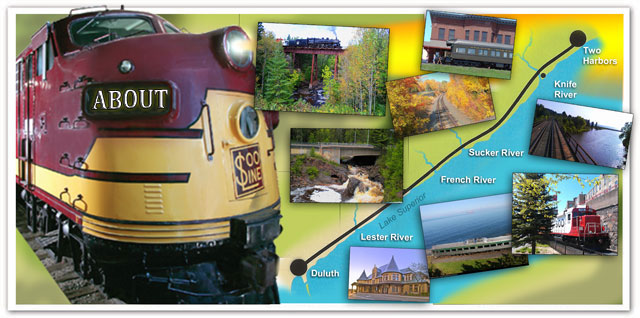
North Shore Scenic Railroad History 1990 1991 1996 Lakefront Line became the North Shore Scenic Railroad The North Shore Scenic Railroad operates excursions along the historic Lakefront Line, a 26-mile section of rail between Duluth and Two Harbors. This rail corridor served a vital link in the transportation system for over 100 years. Known originally as the Lake Division, it connected the isolated Duluth and Iron Range Railway with America's expanding rail network. In 1886, when the Lakefront Line was first built, it was joined by a one-mile extension of the St. Paul and Duluth Railway at Fifth Avenue East in Duluth, providing the D&IR with access to downtown Duluth as well as to other railroad carriers at the Head of the Lakes. As the iron ore industry developed in Minnesota, this new connection provided an all-rail route for the timely delivery of supplies, materials, and personnel to the rapidly growing settlements of the Vermilion Range. It also played a critical role in the development of the Mesabi Range. Before the Lake Division was constructed, prospectors, explorers, and entrepreneurs interested in the exciting prospects of the Mesabi Range had to travel over long and dangerous routes, either by canoe on the St. Louis-Embarrass River chain or on foot or horseback over the Vermilion Trail. From 1886 until 1892, when construction of the Duluth, Mesabi and Northern Railway was finally completed, all transportation moved over the Duluth and Iron Range Railway and its Lake Division to the boom town, Mesabi, where travelers and their supplies were transferred to horse and wagon for a bumpy journey over the Mesabi Trail to the far reaches of the Mesabi Range. Over the years the Lake Division became known as the Lakefront Line. During its long history, a general merchandise train, the Ely Local, transported freight from Endion Yard to Two Harbors and to communities on the Vermilion Range. Cars destined for Mesabi Range cities were set out at Two Harbors to be carried to their destinations by the Virginia Local. During the heyday of logging, thousands of trains carried pine logs to the sawmills in Duluth. One of the principal log suppliers was the Duluth and Northern Minnesota Railroad, which interchanged trains with the D&IR Railway on the Lakefront Line at Knife River. Pulpwood shipments continued over the line until the late 1970s, when highly-competitive over-the-road trucks became the chosen mode of transportation.
In addition to hauling freight, the Before good roadways or reliable automobiles were developed, the D&IR Railway operated two daily mainline passenger trains between Duluth and the Iron Range communities. Each train consist included a parlor-cafe car known for its excellent food, particularly their delicious Minnesota blueberry pies. During the summer months, wealthy patrons from Chicago and other major Midwestern cities enjoyed the splendid train rides as they traveled to and from their summer homes on Lake Vermilion. Another unusual service provided by the D&IR Railway was the "Fisherman's Special," which ran between Duluth and Two Harbors on Sundays during the summer. The morning train stopped at several trout streams along the north shore, where the fishermen were dropped off for a day of fishing. They were picked up in the late afternoon by the returning train.
In the early 1980s changing economic trends and a sharp decline in business prompted the Duluth, Mesabi and Iron Range Railroad, a successor company to the D&IR, to apply to the Interstate Commerce Commission for permission to abandon the Lakefront Line. Members of the Lake Superior Railroad Museum recognized the potential value of the scenic line as an opportunity to interpret history in a dynamic way. To preserve the line, they lobbied successfully for the creation of the St. Louis and Lake Counties Regional Railroad Authority, which purchased the twenty-seven mile railroad with a substantial grant from the State of Minnesota. At a gala celebration held at the Lake Superior Railroad Museum on June 8, 1989, the Lakefront Line was renamed the North Shore Scenic Railroad and was officially dedicated by Governor Rudy Perpich. This significant event closed a century of colorful history.
| |||